
The Other Side of the Counter: How Swisscom Makes Digital Identity Verification Enterprise-Ready
Project Name: Swisscom Credential Validator
With the Swiss e-ID and the EU Digital Identity (EUDI) Wallet on the way, Swisscom is building on open source to help businesses accept Swiss and European digital credentials without managing the trust infrastructure themselves.
Goal
Make it simpler for organizations to integrate Swiss and European digital identity credentials into their existing customer journeys, while reducing the complexity of operating secure and compliant verification infrastructure.
Approach
-
Build Swisscom Credential Validator on two open-source foundations: the Swiss government’s swiyu components and Ubique Innovation’s Kapun SDK, using the Heidi-Platform implementation
-
Add a managed layer that solves four challenges of trust at scale: keys, registrations, governance and proof
-
Deliver it through a single API or as a key-management layer on its own.
Key Challenge?
Adoption, not invention, is the challenge. The open source building blocks exist, but turning them into production services is the hard part. Swisscom is its own first customer, starting with e-ID-based qualified signatures and mobile subscription onboarding, and is a launch partner for Germany's d-you EUDI Wallet, which goes live in January 2027.
Where the Digital Wallet Meets the Business
If you walk into a Swiss mobile shop to sign up for a new subscription, someone will ask for your ID. Swiss law requires telecom providers to verify the identity of every SIM customer and keep a record of the document they checked.
Swisscom, Switzerland’s largest telecommunications and IT company and majority-owned by the Swiss federal government, wants that moment to look different. Instead of handing over a passport or ID card, a customer would open swiyu, the Swiss government’s digital wallet app, present their Swiss e-ID, and share only the details the process actually needs. The check would be cryptographically verifiable, and no physical document would cross the counter.
Most coverage of digital identity focuses on that customer's experience: the wallet, the app, the credential on the phone. Raphael Guye, Technical Lead for Digital Trust at Swisscom and a former software architect for swiyu, is focused on the other side of the counter.
“For the banks, insurers and retailers we work with, joining these ecosystems involves careful consideration, including who carries the liability, and whether they want to assume it,” Raphael says. “We build the compliance and governance infrastructure that helps these industries participate in ecosystems built on open-source projects.”
Where Businesses Get Stuck
Digital identity systems like swiyu and the EUDI Wallet involve three roles. An issuer, usually a government agency, creates a credential and sends it to the person it describes. The holder keeps that credential in a wallet on their own device. A verifier, often a business, asks the holder to present it and checks that it is genuine and unaltered.
Wallets solve the holder's problem, and open source software for the verifier role is freely available. But a business that downloads a verifier still has a long way to go before it can accept a real credential from a real customer. “Trust at scale is an operational problem,” says Raphael.
“Trust at scale is an operational problem.”
Swisscom breaks the problem down into four main challenges:
- Keys. To join an ecosystem, an organization needs a certificate and a private key using the algorithms that ecosystem requires. Those keys need protecting, ideally in a hardware security module (HSM), a tamper-resistant device built to store keys safely. They can never be lost, and they have to be able to change as cryptographic standards change.
- Registrations. Each ecosystem keeps an official registry of the organizations allowed to request credentials, with its own data requirements and its own renewal schedule.
- Governance. When an employee requests a customer's credentials, the request goes out in the company's name. A wrong request binds the company, not the employee.
- Proof. Verifying a credential once isn't always enough. If a company keeps no proof of what was presented, it has no defensible record when a regulator or auditor asks about a know-your-customer (KYC) check later.
“Imagine you want to be part of several ecosystems: the Swiss one, the European one, maybe others in the future,” Raphael says. “You'd have to do all this again for each one.”
For Swiss businesses, “several ecosystems” starts with two. Switzerland is building its own e-ID ecosystem, swiyu, while the EU rolls out EUDI Wallets, and Swiss companies with European customers need both.
The two use the same protocols to exchange credentials but decide who is trustworthy in different ways: Switzerland through its own trust registry, the EU through certificate-based trusted lists. Neither is fully live yet: d-you, Germany’s wallet under the EU framework, makes a silent launch in January 2027, and Switzerland expects its trust infrastructure in the first half of 2027.
Even a large bank may have the resources to build this capability in-house, but still prefer not to take on the associated liability or expand its business scope to include it. For many organizations, those considerations can become a barrier to joining the ecosystem. “We make it one entry point, and we manage it for every ecosystem we support,” says Raphael.
Starting with Swisscom's Own Needs
Digital Trust is Swisscom's division that provides electronic signatures, identity services, and validation services. Its Swisscom Validator portfolio offers API-based checks across several dimensions of digital trust: Credential Validator and Age Validator for people and their credentials, Business Identity Validator for companies and authorized representatives, and Document Validator for electronic signatures and signed documents.
The idea for Credential Validator came partly from customer conversations and partly from Swisscom's own requirements. As a mobile operator, Swisscom has several identity use cases: KYC checks for new contracts, confirming the identity of existing customers who come into a shop, and capturing evidence when a customer uses their e-ID to obtain a qualified electronic signature. Several departments need to request credentials in Swisscom's name, each for different reasons.
About 20 people now work on the product, which began as concept work a few years ago. “We're a user of the services we're building,” Raphael says. “The solution really solved our own problem, and we think it will solve problems for other actors in the ecosystem, too.”
Building on Open Source: swiyu and the Kapun SDK
Credential Validator doesn’t reinvent the verifier. It builds on two open source foundations: the verifier components of swiyu, the Swiss government’s open source e-ID stack, and the Kapun SDK, an Apache 2.0–licensed toolkit for building digital identity wallets and verifiers, developed by the Swiss software company Ubique.
“These two projects are the foundation pillars we rely on,” Raphael says. “The Heidi platform and the Kapun SDK is what allows us to build on top of the EUDI Wallet. It's what makes everything work end to end.”
The relationship runs both ways. “As one of the early testers and integrators in the swiyu ecosystem, we often report the tests we’re doing and the issues we find, and we even submit code changes from time to time,” Raphael says. On the European side, Swisscom works in partnership with Ubique in order to deliver EUDI Wallet verification.
Kapun is part of a wider open source effort around digital wallets and verifiable credentials. Its maintainers proposed it as a project of the OpenWallet Foundation, the Linux Foundation initiative that brings developers and standards organizations together to build interoperable wallet technology. On January 1, 2027, the OpenWallet Foundation becomes part of LF Decentralized Trust, joining a larger ecosystem of identity, cryptography and distributed ledger projects and communities.
Together, swiyu and Heidi (on top of Kapun SDK) handle the standards both ecosystems use. Credentials come in two main formats: SD-JWT VC, which lets a holder reveal selected fields from a credential instead of the whole thing, and mdoc, an ISO standard format that originated with mobile driver's licenses and is also used in the EU. Wallets and verifiers exchange credentials using OpenID4VCI, for issuing a credential into a wallet, and OpenID4VP, for presenting it to a verifier. Think of these protocols as shared rules for how the two sides talk to each other.
Because Credential Validator treats verifiers as interchangeable building blocks, Swisscom can add others as the ecosystems evolve. For Swisscom, though, building on open source is about more than saving development time.
“For a digital identity system to work, trust is what matters most,” Raphael says. “And what's better for trust than open source? It gives everybody the opportunity to understand and trust what has been built.”
“For a digital identity system to work, trust is what matters most. And what's better for trust than open source? It gives everybody the opportunity to understand and trust what has been built.”
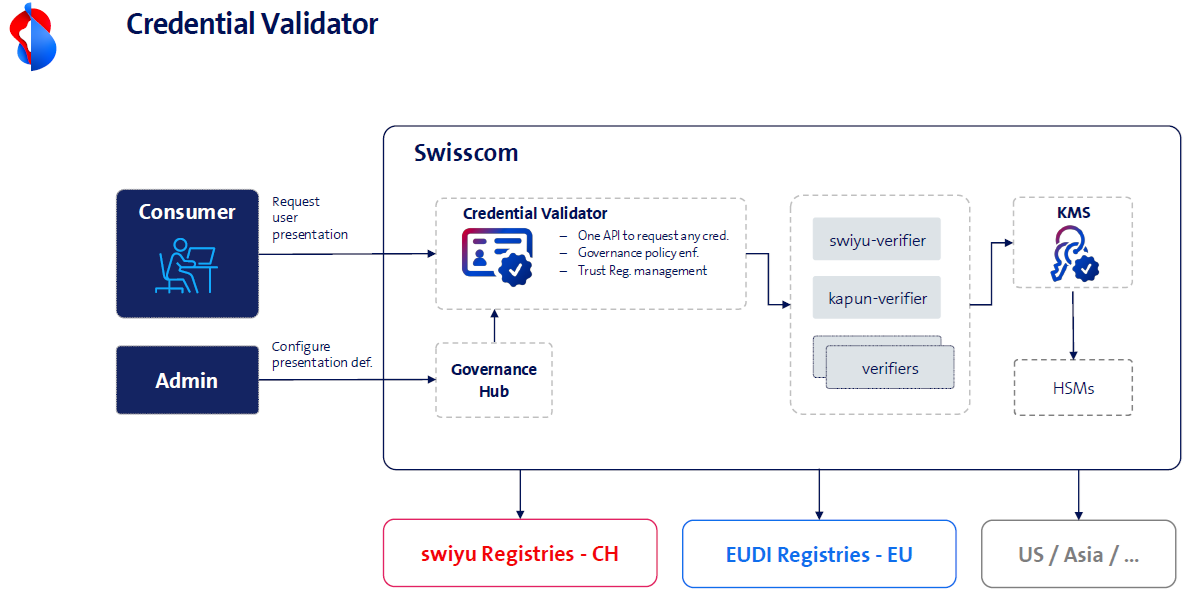
Credential Validator architecture. An application requests a presentation through one API; administrators set policy in the Governance Hub; open source verifiers handle each ecosystem; keys stay in Swisscom's KMS and HSMs.
Wrapping the Trust Infrastructure in a Single API
Building on open source verifiers, Swisscom provides the managed infrastructure businesses need to adopt digital identity verification without building and operating it themselves. Customers connect through a single Credential Validator API. Behind it, Swisscom manages registration in each supported ecosystem, tracks renewals and other governance obligations, and performs key operations through its specialized key management system (KMS), built to manage an organization’s keys and identity in each e-ID ecosystem. The KMS runs on georedundant HSMs in Swisscom data centers in Switzerland, certified to FIPS 140-3 and Common Criteria EAL4+, two widely recognized security standards for cryptographic hardware.
The keys are also crypto-agile by design, meaning the algorithms they use can be swapped as standards change, without rebuilding the service. That gives customers one custody model for swiyu, the EUDI Wallet and whatever ecosystem comes next. Registrations follow a similar principle: one adapter per ecosystem, not one project per ecosystem.
The hardest technical challenge, Raphael says, has been the pace of change. Standards, interoperability requirements and the open source components themselves are all still evolving, and Swisscom has to stay compatible with both the Swiss and European ecosystems. The team's answer is a modular architecture: the components underneath can change while the API customers build against stays stable.
“Of course, not everything works right away. You have to tweak things, and there are late-breaking changes,” Raphael says of sandbox testing so far. “But the communication from the EUDI Wallet community and the Swiss government has been great. For a sandbox environment, there haven't been any real surprises.”
Building Governance into Every Request
Accepting credentials raises a governance problem that is easy to overlook: who inside an organization is allowed to ask for what.
Raphael illustrates with a hypothetical. Suppose Swisscom's HR department is authorized to request every attribute in a citizen's e-ID, while a sales process needs only a first and last name.
“Imagine someone in sales uses the wrong request by mistake and starts asking customers for their full e-ID data in a process that only needs a name,” he says. “That would damage Swisscom's reputation. We need to be sure that only people with the right permissions can make a given request.”
Credential Validator builds those controls into a component called the Governance Hub. Administrators define in advance which credentials and attributes each use case may request, and the policy is enforced before any request leaves Swisscom. That reflects the data minimization principle at the heart of both the Swiss and European ecosystems: ask for no more than a specific use case requires.
Governance works on two levels. Swisscom manages the operation, security, and lifecycle of the Validator service, and it handles integration with the governance requirements of each underlying ecosystem. Customers can participate as verifiers without carrying that complexity themselves.
Some processes also need proof after the fact. As a qualified trust service provider recognized under Swiss (ZertES) and EU (eIDAS) rules, Swisscom issues qualified electronic signatures, which carry legal weight. When a customer presents an e-ID to obtain one, Swisscom must be able to show that this particular person shared their credential. Credential Validator stores that evidence of presentation in an audit-trailed database, so every presentation leaves a record.
Offering the Whole Stack, or Just the Keys
Not every organization needs the full service stack. Raphael points to universities as an example: some have the skills to run open source verifier components themselves but still don't want to operate their own HSMs.
For them, Swisscom has scoped a lighter option. The organization runs its own software built on the open source components, and Swisscom provides only the key management and compliance infrastructure. “You want to build your own software on the open source components the Swiss government provides? That's great,” Raphael says. “We can give you just what you need to manage your keys and stay compliant.”
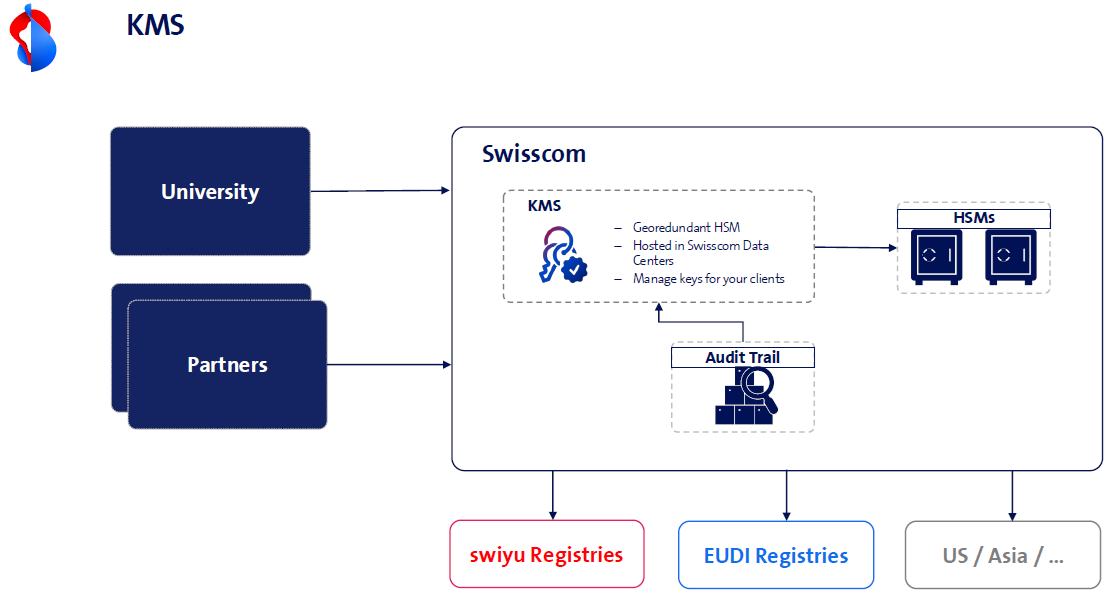
The key-management-only option. Universities and partners run their own software and connect to Swisscom's KMS, which holds keys in georedundant HSMs, keeps an audit trail and handles registrations across ecosystems.
Where Things Stand
With neither ecosystem live yet, Credential Validator is running in sandbox mode while Swisscom tests it in the swiyu Sandbox and the EUDI Wallet sandboxes. The goal is to be ready on the first day each ecosystem opens for real use.
Pilot projects and demos already work. In one demo, an online shop uses Swisscom's Age Validator at checkout: a shopper buying an age-restricted product proves they are old enough with a swiyu or d-you wallet on their phone, without sharing their full identity.
Elsewhere in the portfolio, Business Identity Validator and Document Validator are already in use, particularly in B2B processes where validation can be automated and built directly into existing workflows.
The Validators are also modular, so they can be combined into a single journey. Inside Swisscom, one validation process used to require answering a series of questions by hand: Is this document signed? By whom? Is that person authorized to sign for the company? How many signatures does the company require?
“We have cut that internal process from two hours to 20 minutes by automating every manual step,” Raphael says. Swisscom expects Credential Validator to deliver similar benefits once e-IDs and digital credentials become part of those journeys.
Swisscom also offers e-ID readiness workshops that help organizations map how the e-ID will affect their processes, systems and data, and build a roadmap for adoption.
“We have cut that internal process from two hours to 20 minutes by automating every manual step.”
What’s Next
Credential Validator is designed to work with any EUDI Wallet, since wallets across all 27 EU member states must be compatible with one another. In practice, adoption will happen step by step, and the first milestone is the launch of d-you, Germany’s official wallet under the EU’s digital identity framework, where Swisscom is among the launch partners.
Swisscom is also looking beyond verification. It plans to support credential issuance in the education sector, helping institutions such as universities make trusted information available as verifiable credentials.
Further out, Swisscom is researching who should hold the cryptographic keys for a person, not just a business. One idea is to place them on the eSIM in a customer’s phone, making the mobile operator part of the chain of accountability for personal keys. First results from that work, a master’s thesis with the Swiss armed forces’ Cyber-Defence Campus, are expected in 2027.
“We see Swisscom as one actor in a broader digital trust chain,” Raphael says. “Our goal isn't to build the ecosystem alone. It's to contribute to a living ecosystem where different actors and services work together and create value.”
For Raphael, part of what makes the work worthwhile is that the systems are designed to keep personal data with the person. “When my e-ID is issued, I know it will be issued only on my device, not stored in some central database,” he says. “I like the idea that every citizen in Switzerland, and in the European Union, will have a decentralized e-ID.”
About Swisscom
About OpenWallet Foundation
The OpenWallet Foundation brings together developers and standards organizations to advance global interoperability of verifiable credentials and digital wallet technology. It develops open source engines for secure, interoperable, multi-purpose wallets. Launched by Linux Foundation Europe in 2023, the OpenWallet Foundation becomes part of LF Decentralized Trust on January 1, 2027.