
We are excited to announce the launch of Panurus, a new incubating project within LF Decentralized Trust (LFDT). Panurus is the evolution of Hyperledger Fabric Token SDK, an LFDT lab. Its transition to a project marks a significant step forward for enterprise tokenization, bringing together real-world-proven token infrastructure and vendor-neutral governance and establishing a solid and reusable foundation for blockchain-based asset management.
Panurus [pan-UR-us] addresses three critical requirements that are fundamental to enterprise blockchain applications: Privacy (protecting sensitive transaction data while enabling selective disclosure), Performance (achieving institutional-scale throughput without sacrificing decentralization), and Compliance (providing auditing and regulatory oversight capabilities). By holistically addressing these requirements, Panurus empowers organizations to deploy tokenized assets that comply with real-world regulatory and operational demands.
From Labs to Foundation Stewardship
Panurus began its journey in 2021 within the Labs as Fabric Token SDK, addressing a critical gap in the enterprise blockchain ecosystem: the lack of standardized, reusable token infrastructure. While multiple organizations were building token functionality for assets like cash equivalents, loyalty points, supply chain units, and carbon credits, each was solving the same problems—defining token semantics, handling issuance and transfer logic, implementing privacy requirements, and integrating with blockchain networks—independently.
The current version of Fabric Token SDK, or Panurus, is a mature framework ready for prime time, having powered real-world deployments in some of the most demanding environments imaginable: wholesale central bank digital currency (CBDC) experiments conducted by the Banque de France and the Bank of Canada.
Battle-Tested in Real World Scenarios
Thanks to its evolution from LFDT lab to project, Panurus launches with real-world credentials that speak volumes about its maturity and reliability:
- Banque de France DL3S Platform: The Fabric Token SDK serves as the core token management layer for DL3S (Distributed Ledger for Securities Settlement System), powering Exploratory Cash Tokens (ECT)—the digital form of wholesale central bank money. The platform has underpinned over a dozen wholesale CBDC experiments involving major financial institutions including JP Morgan, HSBC, and multiple Italian banks. The SDK's HTLC-based atomic swap capabilities enable Delivery versus Payment (DvP) settlement across heterogeneous distributed ledgers, demonstrating how it can serve as a programmable cash settlement rail for real-world tokenized financial market infrastructure.
- Bank of Canada Project Samara: Project Samara's platform leveraged the Fabric Token SDK to implement its cash ledger hosting tokenized wholesale central bank deposits (W-CAD). The SDK's UTXO model, wallet-based key management, and configurable privacy levels proved well suited for representing and controlling balances across permissioned ledger participants. Settlement of tokenized bonds against W-CAD was achieved atomically via HTLC-based interledger protocols, enabling real-time T+0 DvP without a central clearing counterparty.
These deployments validate that open source, enterprise-grade token infrastructure can underpin institutional-scale capital markets operations handling real financial assets.
Privacy, Performance, and Compliance: The Three Pillars
Panurus' architecture is built along three fundamental dimensions that are critical for enterprise adoption:
Privacy: Protecting Sensitive Data
Enterprise tokenization requires sophisticated privacy controls to protect commercially sensitive information against unauthorized parties. Panurus offers multiple privacy levels to match different regulatory and business requirements:
- FabToken: Cleartext tokens with X.509 identities for scenarios where the primary concern is full transparency and straightforward auditing.
- ZKAT-DLog: Privacy-preserving tokens using Pedersen commitments and zero-knowledge proofs to hide token types and values from unauthorized parties while supporting Idemix for owner anonymity and unlinkability. This supports confidential transactions where only authorized auditors can decrypt sensitive details.
The Panurus privacy model allows for selective disclosure, whereby organizations prove transaction validity without revealing the details, and authorized auditors are able to inspect transactions, in the clear, for compliance purposes.
Extensible Privacy Architecture: Panurus' driver-based architecture enables the community to develop and integrate new privacy mechanisms. An active LFDT mentorship project is currently delivering a new token driver. The mentorship project is based on the research paper "Privacy-preserving auditable token payments in a permissioned blockchain system" (Androulaki et al.), which describes a token management system tailored for enterprise networks that offers the highest level of privacy and supports fine-grained auditing functionalities for AML/KYC compliance. This new token driver demonstrates how Panurus can evolve to incorporate cutting-edge privacy research and adapt to emerging regulatory requirements.
Performance: Institutional-Scale Throughput
Real-world financial applications demand high transaction throughput and low latency. Panurus achieves institutional-scale performance through:
- Optimized UTxO model: Efficient token selection and parallel transaction processing;
- Strategic caching: Smart state management reduces redundant ledger queries;
- Fabric-X integration: Support for ultra-high-performance backends achieving 100K+ transactions per second; and
- Concurrent transaction handling: Lock-based mechanisms prevent double-spending while enabling parallel operations.
Production deployments have demonstrated the SDK's ability to handle wholesale CBDC operations and institutional trading volumes, validating its performance characteristics for demanding financial use cases.
Compliance: Built-in Regulatory Oversight
Regulatory compliance is non-negotiable for financial applications. LFDT Panurus provides comprehensive compliance capabilities:
- Auditor Service: Authorized auditors can inspect transactions, deobfuscate confidential data, and verify system rules in compliance with regulation and user privacy;
- Immutable audit trails: Complete transaction history with cryptographic proofs are readily accessible;
- Role-based access control: Granular permissions for issuers, auditors, and token holders; and
- Regulatory reporting: Built-in tools for generating compliance reports and demonstrating adherence to token issuance and transfer rules.
These compliance features have been validated in production through CBDC experiments, where regulatory oversight and auditability are paramount.
Comprehensive Token Infrastructure
Beyond the three core dimensions, Panurus provides a complete stack for enterprise tokenization:
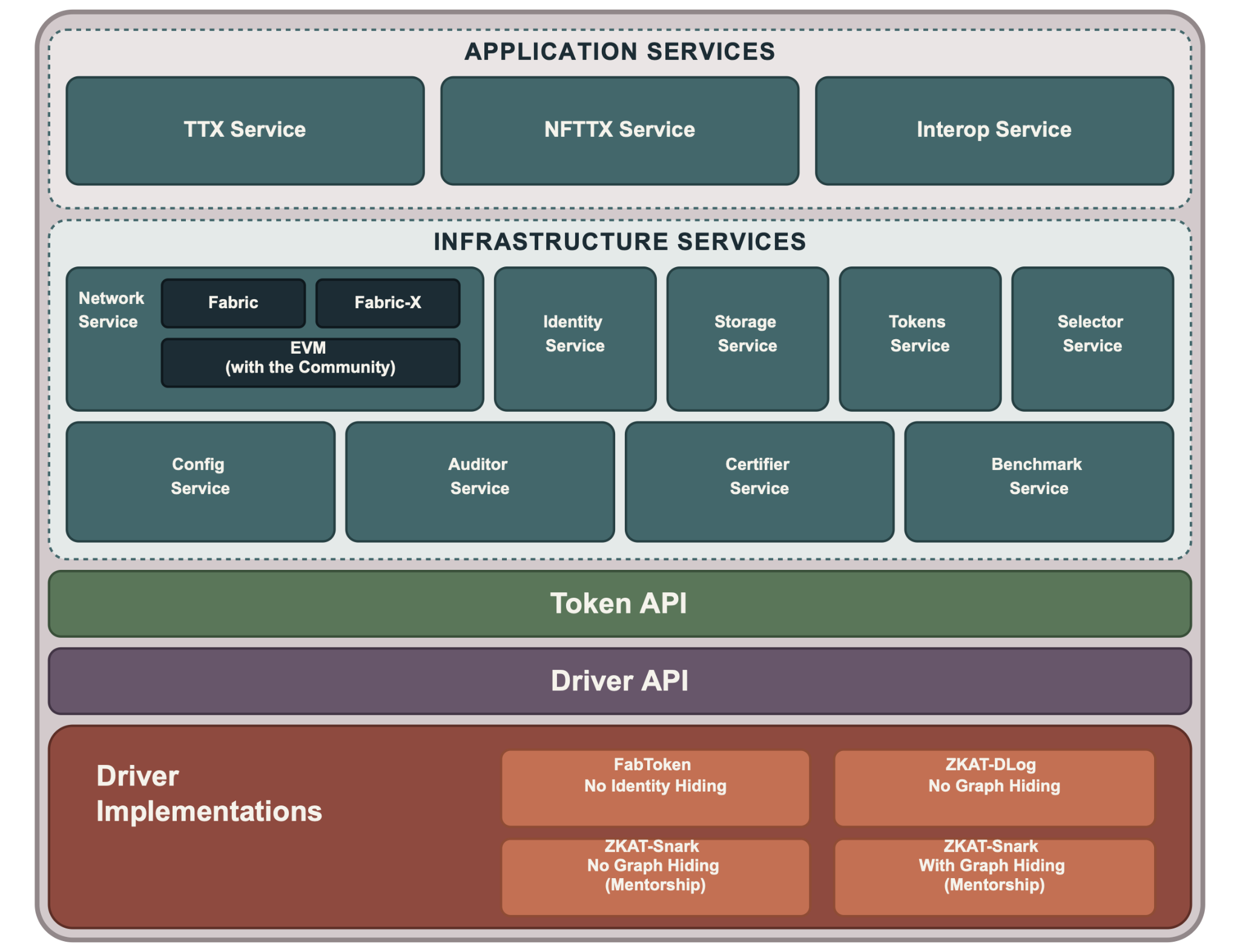
The architecture diagram above illustrates Panurus’ layered design, from high-level application services down through infrastructure services, APIs, and pluggable driver implementations. This modular structure enables flexibility, extensibility, and backend agnosticism.
Multiple Token Models: Support for both fungible tokens (divisible, interchangeable units) and non-fungible tokens (unique assets) with UTxO-based transactions ensures clear ownership and prevents double-spending.
Complete Service Layer: The SDK includes comprehensive services for transaction orchestration (TTX Service), identity management (supporting X.509, Idemix, multisig, and HTLC), SQL-based storage (SQLite, PostgreSQL), strategic UTxO selection with locking mechanisms, and cross-chain atomic swaps via HTLC.
Network Agnosticism: A driver-based architecture decouples token operations from underlying blockchain platforms. Current implementations support Hyperledger Fabric and Fabric-X, with a clear path for Ethereum and other EVM-compatible chains. This design allows core application logic to remain portable while the SDK handles backend-specific integration.
Multi-Platform Support: Built for the Future
One of the Panurus' most powerful features is its backend-agnostic architecture, enabling the same token application logic to run across different blockchain platforms through a driver-based design.
Hyperledger Fabric: The SDK was originally built for this platform, so Panurus provides battle-tested integration with Fabric's chaincode model, endorsement policies, and MSP identity framework. The Fabric driver translates token operations into chaincode invocations and leverages Fabric's proven consensus and ordering mechanisms.
Hyperledger Fabric-X: Panrus fully supports Fabric-X, the next-generation implementation of the Fabric protocol designed for ultra-scalability. Fabric-X reimagines Fabric's architecture to achieve 100K+ transactions per second while maintaining low latency and decentralization. Fabric-X driver enables applications to leverage this high-performance backend through the same token APIs, allowing seamless migration from traditional Fabric deployments to Fabric-X for improved scalability. By using Fabric Smart Client nodes as endorsers rather than traditional chaincode-based endorsement, the Fabric-X driver optimizes performance while maintaining the execute-order-validate model that makes Fabric unique.
EVM-Compatible Blockchains: The community is actively working to extend support to Ethereum and other EVM-compatible distributed ledger technologies. The driver architecture provides two potential implementation paths: smart contract-based validation (where contracts perform full validation logic on-chain) or pre-order execution with off-chain endorsers (similar to the Fabric-X model, reducing gas costs while maintaining security). This extension will enable organizations to deploy the same token applications across permissioned and public blockchain networks.
This multi-platform capability is crucial for enterprises that need flexibility in their infrastructure choices or want to support cross-chain token operations. The SDK's abstraction layer means that switching backends or supporting multiple platforms simultaneously requires only configuration changes, not application rewrites.
Active Development and Community Growth
The project demonstrates strong development velocity and community engagement:
- 39 contributors from diverse organizations including IBM Research, Banque de France, Sign Global, and Offchain Labs;
- 74 commits in the last 30 days showing sustained development;
- 1,047 closed pull requests demonstrating robust code review culture;
- 425 closed issues reflecting effective project maintenance; and
- Two active mentorship programs in 2026 focused on onboarding new contributors and improving developer experience.
The project maintains comprehensive documentation, extensive test coverage (unit, integration, and benchmark tests), and complete community standards compliance (README, CONTRIBUTING, CODE_OF_CONDUCT, LICENSE, SECURITY policy) here.
Why LFDT Governance Matters
LFDT governance addresses several critical needs:
Vendor Neutrality: Foundation stewardship ensures the project evolves based on community needs rather than any single organization's interests, encouraging broader adoption and contribution.
Reduced Duplication: As part of the LFDT ecosystem, Panurus eliminates the need for other projects to build bespoke token implementations, reducing development costs and maintenance burden.
Enhanced Security: Collaborative review and shared testing focus strengthen the security posture, particularly important for infrastructure handling financial assets.
Interoperability: Consistent, openly developed token semantics and transaction flows make it easier for auditors, regulators, and integrators to reason about behavior and risk across different implementations.
Ecosystem Alignment: Close coordination with other LFDT projects around identity, privacy, and asset standards creates opportunities for deeper integration and shared innovation.
Looking Ahead
The Panurus roadmap for the next 12-24 months focuses on:
- Stabilizing core APIs with a v1.0 release and versioned compatibility guarantees.
- Expanding the driver ecosystem with additional privacy-preserving implementations.
- Enhancing network backend support for additional DLT platforms.
- Growing production deployment case studies and reference architectures.
- Establishing regular security audit cadence for critical components.
- Building a diverse maintainer community across organizations.
The project aims to become the default way to build token-based applications on permissioned blockchains while maintaining its backend-agnostic architecture that enables portability across different blockchain platforms.
Get Involved
The Panurus community welcomes contributors at all levels. Get started with these resources:
Explore the code: https://github.com/LFDT-Panurus/panurus
Try the samples: Fabric Samples Token SDK
Read the documentation: Comprehensive guides covering architecture, APIs, drivers, and services: https://github.com/LFDT-Panurus/panurus/blob/main/docs/README.md
Join the community: Monthly community calls; #fabric-token-sdk channel on LFDT Discord
Contribute: Check out the contribution guidelines and development guide
Participate in mentorship projects: LFX mentorship initiatives
Conclusion
The acceptance of the Hyperledger Token SDK as an LFDT incubating project represents a significant milestone for enterprise tokenization. With proven real-world deployments, comprehensive functionality, active development, and now vendor-neutral governance, the SDK is ready for prime time and positioned to become the standard foundation for token-based applications in permissioned blockchains.
By developing reusable, rigorously tested token infrastructure under LFDT stewardship, we are lowering adoption barriers, strengthening security through collaborative review, and helping organizations focus on domain-specific business logic rather than reinventing tokenization solutions.
We invite the broader blockchain community to explore Panurus, contribute to its evolution, and help shape the future of enterprise tokenization under the LF Decentralized Trust umbrella.
---
*For more information about the Hyperledger Fabric Token SDK or Panurus, visit the project repository or read the full project proposal.