
Where LF Decentralized Trust technology actually runs
An inventory of 80 institutional platforms, from central bank payment rails to the world's largest securities depositories, using LF Decentralized Trust tech in production or on a clear path to it. Commissioned from Ledger Insights.
From central banks to G-SIBs
The institutions building on LFDT technology span the full range of financial infrastructure.
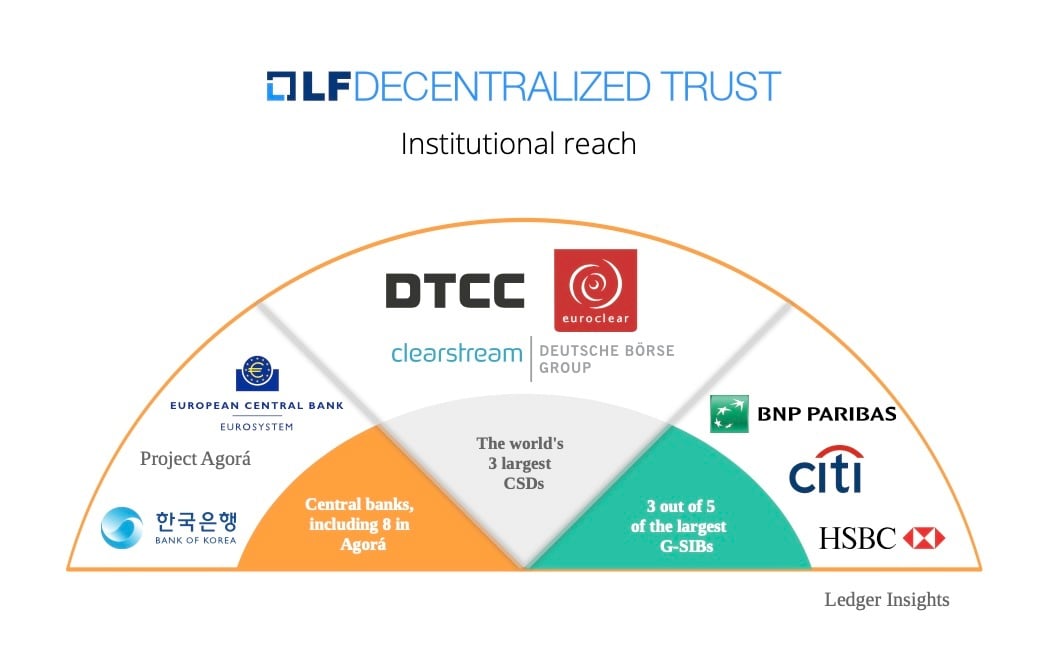
Four numbers that frame the report
From proof of concept to production at scale
The last wave of institutional DLT work was dominated by pilots. This report tracks a different moment: significant projects reaching production, run by the institutions that set the standard for the rest of the market.
Project Agorá, the cross-border payments initiative backed by eight central banks including all G7 economies, runs on Besu. So does the Eurosystem's Project Pontes for wholesale payments in central bank money. Three of the world's largest central securities depositories, Clearstream, DTCC, and Euroclear, have all built projects on Besu, and have been collaborating on joint DLT standards.
The report also finds that the technology choice is the smallest part of the decision. Institutions increasingly need identity, privacy, and interoperability layers above the ledger, which is where much of LFDT's newer project activity now sits.
Biser Dimitrov, Global Head of DLT Center of Excellence at Citi
What's inside
Thirty pages covering the platforms, the architecture decisions behind them, and a full appendix of institutional deployments.
- An inventory of 80 institutional platforms using LF Decentralized Trust technology, in production or on a clear path to it.
- Among institutional platforms that disclose their technology choices, 29.4% run on LFDT projects, one of the most widely adopted technology foundations in institutional digital assets.
- The caliber of the institutions on the list: three of the world's largest CSDs, central banks covering all G7 economies, and three of the five largest global systemically important banks.
- The regulatory and business drivers pushing institutions toward openly governed technology over proprietary alternatives.
- Why the blockchain itself has become the easiest part of a tokenization project, and where privacy, identity, and interoperability tooling like Paladin now do the harder work above the ledger.
A sample from the appendix
The full report lists more than 60 named deployments across central banks, CSDs, and commercial banks.
| Project | Technology | Description |
|---|---|---|
| DTCC Collateral AppChain | Besu | Shared DLT platform for near real-time tokenized collateral management and mobility across financial markets. |
| Deutsche Börse Clearstream's D7 | Besu | Digital and tokenized post-trade issuance platform operated by Deutsche Börse Group and Clearstream. |
| Project Agorá | Besu | BIS and IIF initiative exploring cross-border wholesale payments combining tokenized commercial bank deposits and central bank reserves. |
| Project Pontes | Hyperledger Fabric | Eurosystem initiative enabling wholesale tokenized asset transactions to settle in central bank money via TARGET Services. |
| Citi Token Services | Besu | Tokenized deposits and smart contracts for 24/7 cross-border cash management and trade finance. |
| Fnality | Besu | Consortium-backed wholesale payment and settlement system using central bank money-backed tokens. |
Continues for 55+ more entries, including central bank digital currencies, trade finance platforms, and tokenized securities infrastructure across Asia, Europe, the Middle East, and Latin America.
Read the full report
Findings, architecture breakdowns, and the complete deployment list, compiled by Ledger Insights and prefaced by LFDT's Daniela Barbosa.