
Clarity, Credibility, and Collaboration: New Outreach Committee Leaders Share Their Vision
The work of building the LF Decentralized Trust (LFDT) brand, clearly communicating its value to the market and members, and engaging the global community of developers and adopters is what grows our ecosystem and, ultimately, drives demand for decentralized trust technologies. Through the Outreach Committee, our members all have the opportunity to shape this work, creating new opportunities for LFDT and themselves.
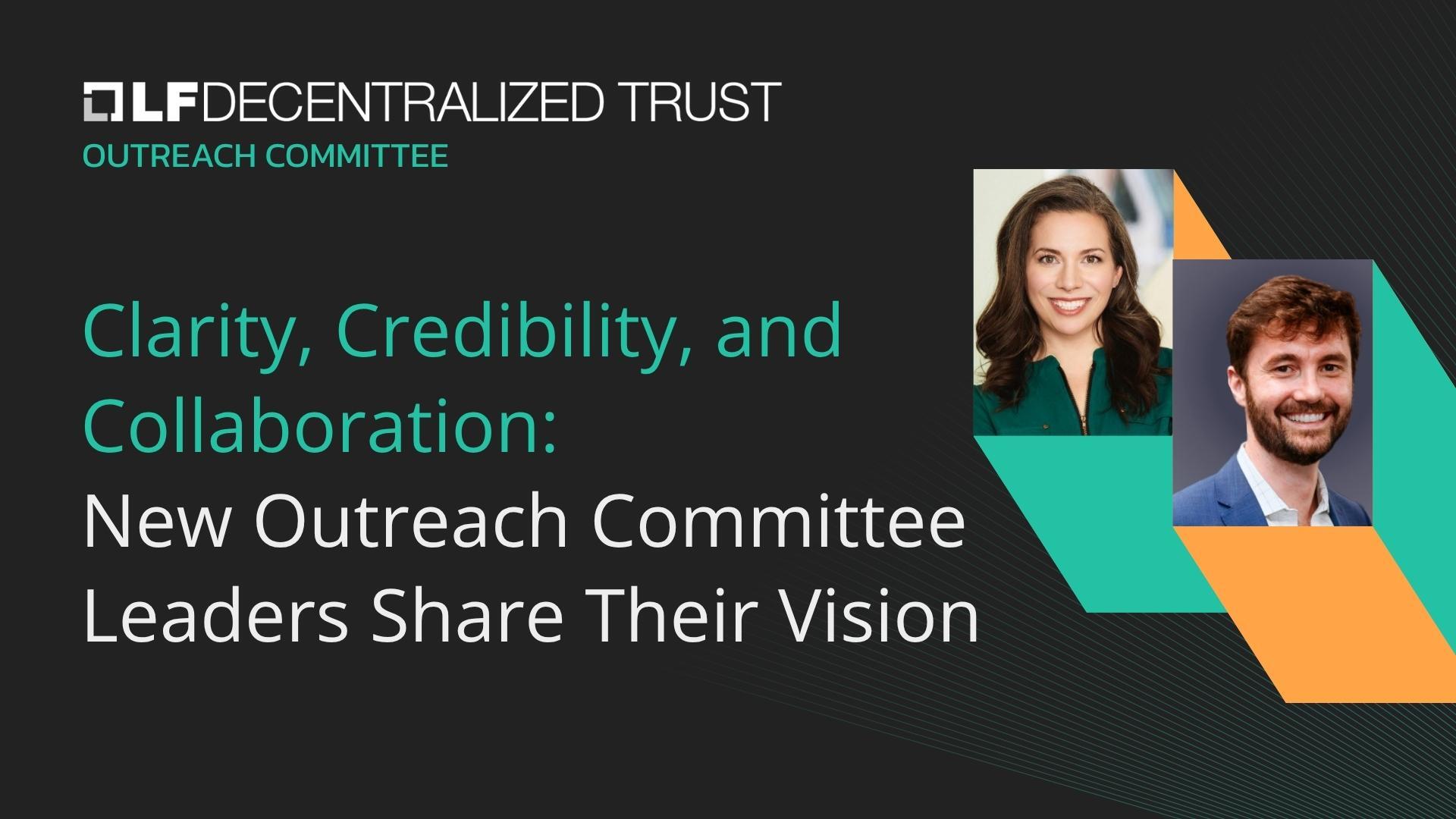
Per the LFDT charter, the Outreach Committee is a members-only committee, led by a nominated and Governing Board-elected chair and vice chair, that is responsible for the design, development, and execution of community outreach efforts. This year, the committee is chaired by Ashley O’Brien, Marketing Manager, Capital Markets at Chainlink Labs. Marcello Gracietti, CEO at Cheesecake Labs, serves as the vice chair.
To kick off their tenure as the leadership for this important committee, we asked Ashley and Marcello about their take on the role of the Outreach Committee, their approaches to its work, and what they view as success. Read on for their answers:
1. You are taking the reins of the Outreach Committee as market adoption is accelerating and the LFDT project ecosystem is expanding. What role do you see for the marketing committee in helping LFDT and its members gain maximal traction as the market matures?
[Ashley] As the market matures, the role of the Outreach Committee becomes less about awareness and more about clarity, credibility, and coordination. There’s no shortage of innovation in the LFDT ecosystem. The challenge is making that innovation tangible and relevant to the audiences that matter.
I see the committee acting as a unifying layer across projects: helping translate highly technical advancements into clear value propositions, elevating real-world use cases, and ensuring that members are not operating in silos. By aligning messaging, amplifying success stories, and creating shared narratives around decentralized trust, we can position LFDT as the authoritative voice in the space and help members capture meaningful adoption, not just attention.
[Marcello] Because everything we build is open source, we often don't have full visibility into how our projects are being adopted or what challenges teams are running into in production. That's a unique problem for our ecosystem. The Outreach Committee's role is to close that gap by surfacing real stories and real use cases, what worked, what didn't, and what others can learn from it. When we do that well, the whole community learns faster and evolves faster together. As adoption accelerates, the committee becomes the connective tissue between the builders doing the work and the broader market that needs to understand why it matters.
2. What are the program elements that you think are most vital to success? And how can members support these efforts? Capitalize on them?
[Ashley] Three elements stand out as critical:
- High-quality, use-case-driven content that demonstrates real-world impact
- Coordinated campaigns that bring members together around shared themes
- Ecosystem storytelling that highlights interoperability and collective progress
Members can support these efforts by actively contributing case studies, data points, and subject matter expertise. The more we can ground our narratives in tangible outcomes - whether that’s institutional adoption, developer traction, or new business models - the more compelling our collective story becomes.
There’s also a strong opportunity for members to co-market. Joint announcements, co-authored content, and shared event presence allow everyone to benefit from network effects while reinforcing the strength of the ecosystem as a whole.
[Marcello] For me, the most vital element is making sure the right channels exist so that each audience can connect in the way that's most natural to them. Builders need spaces to connect with other builders so they can share technical learnings and move faster. Business development teams need visibility into what other members are doing so they can find collaboration opportunities. And institutions, which often have more constraints around what they can share publicly, need environments where they feel comfortable participating.
But it's not enough to serve each group in isolation. We also need to create ways for those audiences to talk to each other, so that technical, product, and business perspectives stay aligned. The member spotlights, contributor stories, newsletters, and events the committee supports are all vehicles for this. Members can support these efforts by sharing their own experiences openly and by engaging with the content we produce together.
3. How do you plan to balance the mix of audiences (technical, business, builders, institutions, etc.) in your approach?
[Ashley] It starts with recognizing that these audiences don’t need separate stories—they need different entry points into the same story.
We’ll focus on developing layered messaging frameworks. At the core is a consistent narrative around decentralized trust and its value. From there, we tailor how that story is expressed:
- For developers, it’s about tooling, composability, and technical differentiation
- For institutions, it’s about reliability, standards, and risk mitigation
- For business leaders, it’s about ROI, efficiency, and new revenue opportunities
The goal is not fragmentation, but coherence—ensuring that regardless of audience, they’re all converging on a shared understanding of why this technology matters now.
[Marcello] I love technology. My background is in engineering. But I believe the market and real use cases should drive everything else. So the approach is to lead with the outcomes and applications that matter to each audience, then let the technical depth follow naturally. A builder wants to know how a project performs in production. A business leader wants to understand the ecosystem opportunity. An institution wants to see governance and compliance credibility. The content and channels we use should reflect those different entry points, but the underlying stories are often the same. It's about framing, not fragmentation.
4. The pace of innovation is creating market opportunities for our members. However, it is also disrupting traditional marketing and content strategies. How can the outreach committee help members stay ahead of the curve on both fronts?
[Ashley] We’re operating in an environment that’s being defined in real time, which means traditional playbooks need to evolve. The committee can play a key role in helping members adapt by acting as both a signal amplifier and a knowledge hub.
That includes:
- Identifying emerging narratives early and helping shape them
- Sharing best practices across the ecosystem in real time
- Experimenting with new formats—whether that’s technical deep dives, interactive content, or more data-driven storytelling
Equally important is speed. The ability to quickly translate innovation into clear, accessible messaging is a competitive advantage. By creating lightweight frameworks and reusable assets, we can help members move faster without sacrificing quality or consistency.
[Marcello] As more and more content becomes AI-generated, there's a real risk of noise drowning out signal. I think we have a unique opportunity here. LFDT is a curated community where the content we produce is grounded in actual experimentation and real deployments. We can absolutely use AI to help write and distribute content more efficiently, but the data and the insights come from our members' hands-on work. That's what makes it credible. The committee's job is to make sure we stay focused on that authenticity and help members turn their technical work into visible thought leadership, which in turn opens market opportunities.
5. What are your top priorities for the Outreach Committee in the next 6–12 months?
[Ashley] My priorities fall into three areas:
- Strengthening the LFDT brand narrative: Establishing a clear, differentiated position for LFDT in the broader decentralized technology landscape
- Scaling content and campaigns: Building repeatable programs that consistently showcase member innovation and drive engagement
- Deepening member collaboration: Making it easier for members to co-create, co-market, and benefit from shared visibility
If we can execute on those fronts, we’ll not only increase awareness—we’ll drive meaningful ecosystem growth.
[Marcello] My top priority is building a culture of transparent collaboration. The members in this ecosystem are doing incredible work, but too often that work stays invisible. I want us to get more comfortable sharing what's working and what's not, openly. When we do that, everyone evolves faster, fails faster in the right direction, and builds on each other's progress instead of starting from scratch. Concretely, that means supporting the member storytelling programs we have planned, making the monthly and bi-weekly calls genuinely useful forums for exchange, and helping surface regional stories from places like Brazil and India where adoption is accelerating.
6. What does success for this committee look like to you?
[Ashley] Success is when the LFDT ecosystem is recognized not just for its innovation, but for its impact.
That means:
- More real-world adoption stories tied back to our members
- Stronger alignment and collaboration across the ecosystem
- A clear, consistent narrative that resonates across technical and non-technical audiences
Ultimately, success is when LFDT becomes the default reference point for decentralized trust—and when our members see tangible value from being part of that collective story.
[Marcello] Success means two things. First, improving the collaboration and visibility among existing members so that the value of being part of this ecosystem is obvious and felt, not just stated. Second, attracting new members that genuinely make sense for the current community, organizations that bring relevant expertise, real use cases, and a willingness to contribute.
If by the end of the year our members feel more connected, more visible, and more supported in telling their stories, and if the right new organizations are joining because they can see that value from the outside, then we've done our job.
___
The monthly, members-only Outreach Committee call is the first Tuesday of every month at 11:00 am ET/8:00 am PT. There is also a monthly call for Outreach Committee members in Asia Pac. It is the first Wednesday of the month at 11:30am India ST/2pm HKT Singapore/3pm JST.
To sign up for the Outreach Committee email list, please contact the LF Decentralized Trust marketing team. If you aren’t a member of LF Decentralized Trust, talk to us about joining so you can be part of this growth-focused community. Email our ecosystem team here.